For independent novelists, short story writers, web serial authors, and amateur writers in the United States, creating fiction has always been a task that consumes a great deal of inspiration and energy. Many creators have excellent story ideas but often get stuck on character development, plot progression, dialogue writing, and world-building. Repeatedly encountering writer’s block, getting stuck in the middle of a story, and running out of inspiration are common pain points shared by the vast majority of fiction writers.
Today, AI fiction writing tools are radically transforming the creative process for fictional content. Rather than writing entire novels for authors, these tools generate content based on prompts, helping creators overcome writer’s block by developing character profiles, devising plot directions, polishing dialogue, and expanding story worlds—all while significantly reducing the time required for initial planning. General-purpose AI tools designed for marketing copy are better suited for producing commercial and SEO-optimized text, but the stories they generate tend to be stiff and formulaic. In contrast, AI writing tools specifically designed for fiction have been optimized for fictional narratives, character dialogue, and atmospheric descriptions. If you’re a fiction writer looking to boost your productivity, familiarizing yourself with high-quality AI fiction writing tools can help you focus more of your energy on core creative elements.
When selecting an AI writing tool suitable for novel writing, the first step is to understand the actual search needs of American fiction writers, distinguish the positioning of different tools, and avoid forcing marketing-oriented AI to handle novel creation. The needs of different writers vary greatly: some authors primarily write long-form fantasy novels and require management of vast world-building; others focus on short suspense or romance stories and need to quickly generate character dialogue; and many independent writers have limited budgets and prioritize the capabilities of free versions. While some general-purpose large language models can write stories, they have obvious shortcomings and are prone to issues such as inconsistent character development, plot holes, and erratic writing styles. When screening tools, you should focus on several key metrics: character memory, support for long-form context, style customization, copyright terms, and free usage limits. For U.S. writers, copyright is of the utmost importance. You must confirm that ownership of AI-generated content belongs entirely to the creator to avoid copyright disputes when publishing or listing e-books on Amazon. Blindly choosing the most popular AI tools often results in cookie-cutter, assembly-line-style story text that fails to preserve your unique storytelling style.
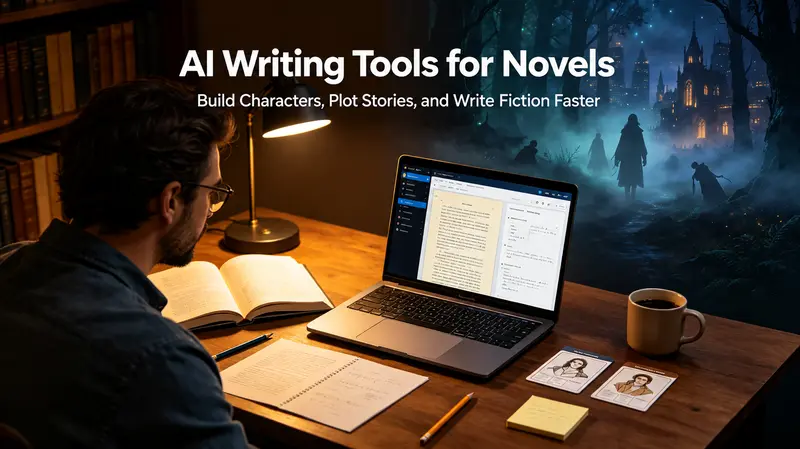
The primary distinction between AI tools designed specifically for novel writing and general-purpose AI writing tools lies in their ability to retain memory regarding characters and world-building. Writing a full-length novel involves hundreds of pages of content; maintaining consistency in character personalities, backstories, physical traits, and relationships is crucial. Standard free versions of tools like ChatGPT have limited context windows; once the text exceeds a certain length, they tend to “forget” earlier details, leading to amateurish errors such as incorrect character names or sudden, illogical shifts in personality. In contrast, specialized novel-writing AI tools allow you to input comprehensive character backgrounds and the rules of your story’s world. These tools retain this information throughout the process, ensuring narrative consistency. Many independent novelists in the US prioritize this feature, as constantly fixing character inconsistencies consumes a vast amount of creative time. These AI tools also support customizable writing tones, enabling you to emulate styles ranging from Gothic and sci-fi to contemporary romance and noir suspense. You can use the AI to generate initial drafts or to rewrite existing passages—enhancing atmosphere, adjusting the tone of dialogue, and ensuring characters speak in ways that align with their identities.
The capabilities of free versions are a practical concern for the vast majority of amateur novelists and independent creators in the US. Many aspiring users are reluctant to commit to high monthly subscription fees right from the start. While several mainstream novel-writing AI tools offer free plans, the quality varies significantly between them. Some tools provide enough free allowance to complete a short story but impose strict word-count limits on longer works; others restrict the stylistic range of the output, resulting in bland, uninspired prose. Additionally, some platforms retain usage rights to content created under their free tiers, so it is essential to read the terms of service carefully. For beginners, it is advisable to test a tool’s suitability using the free mode first. Focus your testing on whether characters stay true to their established personalities (avoiding “OOC” or “out-of-character” moments), whether descriptions become repetitive, and whether the tool can produce text that matches the tone of your story. Avoid pasting an entire unfinished novel at once; instead, test in segments to see if the tool can consistently maintain the narrative flow before deciding whether to upgrade to a paid plan.
AI novel-writing tools can handle a wide variety of supporting tasks, but creators must clearly understand the proper role of AI: it is a collaborative partner, not a robot designed to replace writers. Within the American writing community, there has long been controversy surrounding AI-generated fiction, with many creators worried that AI will undermine originality. The reality is that the best way to use AI is for humans to firmly hold onto the core creative vision. You can use AI to perform tasks such as: outlining a story, generating alternative plotlines, writing dialogue for secondary characters, describing the atmosphere, overcoming writer’s block, revising rough drafts, and providing inspiration for different endings. However, the core theme, the essence of the characters, and the emotional core of the story must still be controlled by the author. If you leave it entirely up to AI to generate a complete novel, the final product will be riddled with clichéd plot devices and is unlikely to gain reader approval on Amazon’s e-book platform. Only by understanding how to divide labor between humans and AI can you maximize the value of these tools.
Copyright terms are a critical aspect that American novelists absolutely cannot overlook, as they directly impact your subsequent publishing, e-book releases, and online serialization. User agreements vary greatly across different AI fiction platforms. Some tools explicitly state that users own all rights to the generated content, allowing you to freely use the work for commercial publication or self-publishing via Amazon KDP; however, many platforms reserve partial usage rights for AI-generated content or impose restrictions on commercial use for free users. If you’re simply writing stories as a personal hobby, copyright restrictions won’t have much impact; but if you plan to publish and sell your novel for profit, you must thoroughly review the platform’s terms of service. Never assume that all AI..Many independent American authors have fallen into this trap: only after completing their work did they discover that the agreement prohibited commercial release, resulting in a significant waste of time spent creating it.
Try using two tools in tandem: one for building your world and designing character profiles, and the other for polishing prose and generating story segments. At the same time, do not rely solely on online rankings; the best way to verify performance is to test the tools yourself. Take a sample of your own fiction, input the same prompts, and compare the quality of the output to see which tool best aligns with your personal writing style.
Overall, AI fiction-writing tools are powerful assets for contemporary fiction writers, though the ultimate potential of the work is always determined by the creator’s own imagination. Whether you are a hobbyist writing short stories or an author preparing to publish a full-length independent novel, AI can help you overcome writer’s block, reduce repetitive tasks, and unleash your creative imagination.