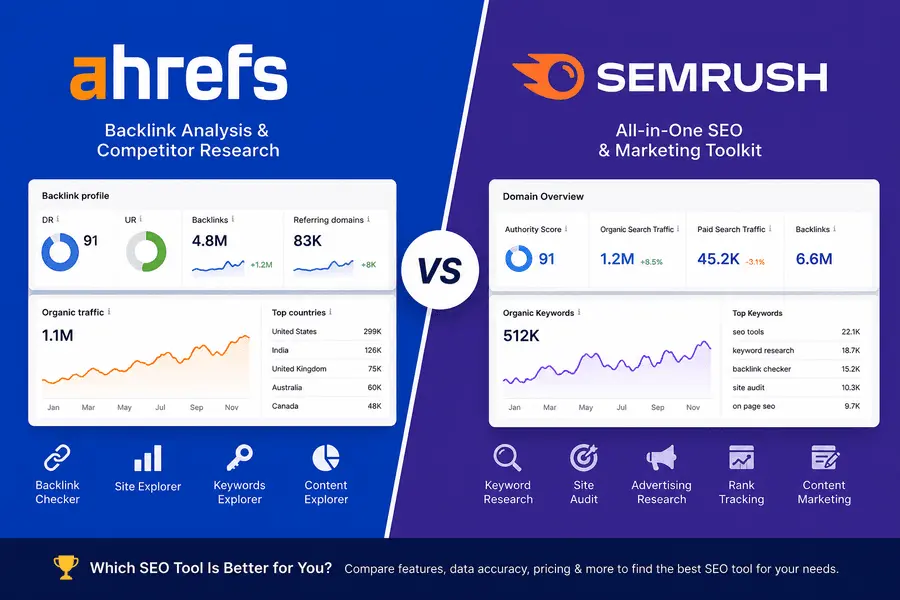
Choosing between Ahrefs and Semrush can be difficult because both platforms cover many of the core tasks involved in modern SEO. Ahrefs is widely associated with backlink research, competitor analysis, keyword research, and organic search data, while Semrush provides a broader digital marketing toolkit that extends beyond traditional SEO.
The right choice depends less on which platform is “better” overall and more on how you plan to use it. An SEO specialist focused heavily on link analysis may have different priorities from an in-house marketer managing SEO, content, competitors, and paid search campaigns.
In this Ahrefs vs Semrush comparison, we examine their major features, keyword research capabilities, backlink analysis, competitor research, site auditing, rank tracking, pricing considerations, and overall usability to help you decide which platform better fits your workflow.
1. Ahrefs vs Semrush: Quick Comparison
Ahrefs and Semrush overlap considerably, but their strengths are not identical. Ahrefs provides tools such as Site Explorer, Keywords Explorer, Site Audit, Rank Tracker, and Content Explorer. Its interface makes it relatively straightforward to move from analyzing a competitor’s domain to examining its organic keywords, backlinks, top-performing pages, and referring domains.
Semrush takes a broader approach. Alongside keyword research, backlink analysis, rank tracking, and technical SEO auditing, the platform includes additional tools covering areas such as advertising research, content marketing, local marketing, and competitive intelligence.
For users primarily interested in organic search and backlink research, Ahrefs can offer a focused SEO workflow. For marketers who want SEO to sit alongside PPC and other digital marketing activities within one ecosystem, Semrush may provide greater breadth.
The important point is that neither tool wins every category. Your ideal choice depends on the data and workflows you use most frequently.
2. Ahrefs vs Semrush: Key Features
When comparing Ahrefs vs Semrush features, both platforms provide most of the functionality an SEO professional needs for everyday optimization.
Ahrefs organizes much of its workflow around several core products. Site Explorer is used to investigate websites and competitors, Keywords Explorer handles keyword research, Site Audit identifies technical SEO issues, and Rank Tracker monitors search positions. Content Explorer can also help identify successful content and potential research opportunities.
Semrush provides comparable SEO capabilities through tools such as Domain Overview, Organic Research, Keyword Magic Tool, Backlink Analytics, Site Audit, and Position Tracking. However, its feature set extends further into areas such as paid advertising research and other marketing workflows.
This difference matters when choosing between them. A dedicated SEO consultant may prefer a more concentrated SEO research environment, while a marketing team responsible for several acquisition channels may appreciate having more functions within a single platform.
Rather than comparing feature counts alone, consider which features will actually become part of your weekly workflow.
3. Which Tool Is Better for Keyword Research?
Keyword research is one of the most important areas in any Ahrefs vs Semrush comparison because both platforms are frequently used to discover search opportunities.
Ahrefs Keywords Explorer allows users to enter seed keywords and examine metrics and related keyword ideas. It is particularly useful when moving between keyword research and competitor analysis because you can investigate which queries drive organic visibility to competing websites and then examine their ranking pages.
Semrush’s Keyword Magic Tool also provides extensive keyword discovery and filtering capabilities. Users can group and filter keywords based on factors such as intent, volume, difficulty, and other metrics, making it useful when building larger keyword lists and content plans.
For a small niche website, either platform can provide more keyword data than you are realistically able to target. The bigger difference is workflow.
Instead of choosing purely on database size, evaluate how easily each tool helps you move from keyword discovery → search intent → competitor analysis → content planning → execution.
4. Ahrefs vs Semrush for Backlink Analysis
Backlink analysis has historically been one of Ahrefs’ best-known use cases. Site Explorer allows users to investigate a domain’s backlinks, referring domains, anchor text, linked pages, and changes in its link profile.
This makes Ahrefs particularly useful for competitive link research. For example, instead of simply looking at how many backlinks a competing SaaS website has, an SEO professional can investigate which pages attract those links and which referring websites appear relevant enough to pursue.
Semrush also provides a comprehensive backlink analytics toolkit. It can be used to examine backlinks, referring domains, anchors, competitors, and potential link-building opportunities.
For practical SEO work, raw backlink totals should not determine your decision. The more important question is whether the tool helps you identify relevant and credible linking opportunities.
For users whose workflow revolves heavily around backlink research and competitor link profiles, Ahrefs remains particularly attractive. Semrush, however, can be more convenient when backlink research forms only one part of a broader marketing workflow.
5. Which Tool Is Better for Competitor Analysis?
Both Ahrefs and Semrush are powerful competitor research platforms, but they encourage somewhat different workflows.
With Ahrefs Site Explorer, you can enter a competitor’s domain and investigate its organic keywords, top-performing pages, backlink profile, referring domains, and changes in organic visibility. This makes it useful for answering practical questions such as: Which competitor pages receive the most organic traffic? Which topics consistently perform? Where are competitors earning links?
Semrush offers similar organic competitor research but combines it with a broader competitive marketing perspective. Depending on the available tools and subscription level, marketers can investigate competitors across organic search and paid search while exploring keyword and market overlaps.
For pure SEO competitor research, Ahrefs provides a highly focused experience. For businesses that want to examine competitors from a wider digital marketing perspective, Semrush may offer additional context.
Whichever platform you choose, competitor data should be used to discover opportunities—not simply to copy competing websites.
6. Ahrefs vs Semrush for Site Audits
Technical SEO audits are another area where both platforms provide strong functionality.
Ahrefs Site Audit crawls a website and reports potential technical and on-page SEO problems. These can include internal linking issues, indexability concerns, redirects, duplicate or problematic content elements, and other crawl-related issues. Reports can then be used to prioritize fixes.
Semrush Site Audit follows a similar principle. It crawls the website, groups detected issues by severity, and provides information that can help marketers and site owners understand what needs attention.
For smaller WordPress websites, either solution is capable of identifying many common technical problems. However, an audit score should never replace professional judgment.Smaller sites that do not need a full paid platform can begin with the best free SEO audit tools for 2026 to check common on-page and technical SEO issues.
A warning does not automatically mean something must be changed. SEO professionals should evaluate whether an issue genuinely affects crawling, indexing, user experience, or organic performance before implementing a fix.
Therefore, the better audit tool is often the one whose reports you can interpret and turn into practical actions most efficiently.
7. Ahrefs vs Semrush for Rank Tracking
Rank tracking allows SEO teams to monitor whether targeted keywords are moving up or down in search results over time.
Ahrefs Rank Tracker lets users create keyword-tracking projects and monitor rankings across selected locations and devices. This is useful when you want to connect ongoing optimization work with changes in search visibility.
Semrush Position Tracking provides a comparable workflow, allowing users to monitor selected keywords, locations, competitors, and SERP visibility.
Neither should be viewed as a perfect representation of every Google search. Search results can vary by location, device, personalization, SERP features, and other factors.
More importantly, rankings should not be analyzed in isolation.
A keyword moving from position 30 to position 12 can represent meaningful progress even if it produces little traffic yet. Conversely, ranking first for a keyword with almost no relevant search demand may contribute little business value.
Use rank tracking alongside Google Search Console data, organic traffic, and conversion metrics.
8. Ahrefs vs Semrush Pricing
Pricing can become one of the deciding factors when comparing Ahrefs and Semrush, particularly for freelancers, small businesses, and independent website owners.
Both products are premium professional SEO platforms, and the real cost depends on the plan, usage requirements, limits, additional users, and features you need. Because SaaS pricing and plan structures can change, buyers should always verify current plans directly on the vendors’ official websites before subscribing.
The better question is not simply, “Which one is cheaper?”
Instead ask:
Which tool will I actually use enough to justify the subscription?
An agency conducting competitor research and keyword analysis every day may generate substantial value from a professional SEO platform. A small website publishing only several articles each month may not need the same level of access.
Before subscribing, list your required tasks—keyword research, backlinks, rank tracking, audits, competitor research, PPC research—and determine which platform covers those tasks with the least unnecessary complexity.
9. Pros and Cons of Ahrefs and Semrush
Ahrefs’ main advantage is its strong focus on SEO research. Its backlink analysis, competitor exploration, keyword research, and content research tools work together naturally, making it particularly useful for people whose daily work centers on organic search.
The trade-off is that users seeking a broader digital marketing platform may find Semrush’s wider ecosystem more suitable.
Semrush’s biggest advantage is breadth. SEO teams can conduct keyword research, technical audits, backlink analysis, rank tracking, and competitor research while accessing additional marketing capabilities within the same ecosystem.
That breadth can also be a disadvantage. New users may encounter more dashboards, reports, and functionality than they actually need.
A simple way to think about the difference is:
Ahrefs: particularly compelling for SEO-focused research and backlink/competitor workflows.
Semrush: particularly compelling for teams wanting SEO combined with a wider range of digital marketing research and tools.
Neither advantage makes one platform universally superior.
10. Ahrefs vs Semrush: Which One Should You Choose?
The final Ahrefs vs Semrush decision should depend on your role, workflow, and business objectives rather than which brand appears most frequently in SEO discussions.
Choose Ahrefs if backlink research, organic competitor analysis, keyword discovery, and SEO content research form the core of your work. Its tools are well suited to users who spend significant time investigating why websites rank and where their organic visibility comes from.
Choose Semrush if you want a broader marketing toolkit combining SEO research with paid search and other competitive marketing capabilities. This can make it attractive to in-house teams, agencies, and marketers responsible for more than organic search alone.
For an independent blogger or small website, however, purchasing both platforms is often unnecessary. Identify the SEO tasks you perform most frequently, compare the current plans and limits, and test the workflow before committing.
Ultimately, the best SEO platform is not the one with the longest feature list. It is the one that helps you turn data into better SEO decisions consistently.
FAQ
Is Ahrefs better than Semrush?
Not universally. Ahrefs is particularly strong for SEO-focused competitor and backlink research, while Semrush offers a broader digital marketing toolkit.
Is Semrush better for beginners?
That depends on the user’s goals. Semrush offers extensive functionality, but the number of available tools can also create a steeper learning curve for users who only need basic SEO research.
Can I use both Ahrefs and Semrush?
Yes, and agencies or larger SEO teams sometimes benefit from comparing data across platforms. For smaller websites, however, paying for both may be unnecessary.
Can Ahrefs or Semrush replace Google Search Console?
No. Third-party SEO platforms provide estimates and proprietary metrics, while Google Search Console provides first-party information about how your site performs in Google Search. They are complementary tools rather than replacements.